
New Partnership to Restore and Protect Critical Seagrass Meadows in Talamone Bay
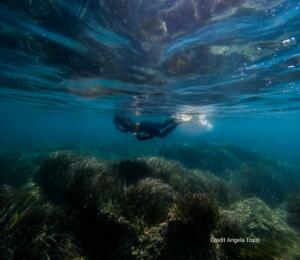
We are thrilled to announce an exciting new partnership between DECIEM, Conservation Collective, and Tuscany Environment Foundation to protect and restore vital seagrass ecosystems in Tuscany thanks to a new funding of £ 24,671.
Seagrass meadows play a vital role in supporting the health of oceans and coastal ecosystems. They are responsible for storing up to 18% of the carbon found in the world’s oceans, improving water quality through natural filtration, and serving as essential nursery grounds for a wide range of marine species. In addition, over 20% of the world’s top fisheries depend on seagrass habitats, making their decline a direct risk to global food security. Despite their significant ecological importance, seagrass meadows are increasingly threatened by unsustainable anchoring practices, pollution, and rising ocean temperatures.
To combat this urgent crisis, TEF is channelling resources to a crucial grassroots initiative right here in Italy.
The Project: Talamone Bay Seagrass Restoration
Talamone Bay’s delicate seagrass ecosystems have been under severe pressure from habitat degradation, declining water quality, and decades of anchor damage.
Through this new funding and strategic alliance, Tuscany Environment Foundation is supporting the Bioscience Research Centre (BsRC) to launch an innovative seagrass restoration pilot program. The star of this project is Cymodocea nodosa, a fast-growing and heat-resilient seagrass species whose recovery offers tremendous promise for strengthening coastal protection, improving water quality, and restoring marine biodiversity.
The project will follow a rigorous two-year timeline:
– Year 1: Scientists will cultivate and propagate Cymodocea nodosa shoots within specialized laboratory facilities, utilizing local donor meadows.
– Year 2: The laboratory-grown shoots will be transplanted onto an initial 15 m² test area, trialing different proven methodologies to reverse anchor damage and bring the degraded coastal habitat back to life.
This pilot program is designed to look far beyond Talamone Bay. Throughout its implementation, scientists will develop baseline data and a standardized methodology for scaling up Cymodocea nodosa restoration. By creating scalable best-practice models, this project will enable other conservation groups to replicate the work across Tuscany and beyond, securing a long-term future for Mediterranean marine environments.
A meaningful partnership
The project is part of a broader collaboration between DECIEM and Conservation Collective, aimed at supporting locally driven environmental initiatives through Conservation Collective’s international network of foundations. This partnership is dedicated to the protection and restoration of seagrass ecosystems in key areas throughout the Mediterranean, bringing together scientific knowledge, community participation, and policy advocacy to generate long-term, scalable impact.
Alongside the work in Tuscany, the partnership is also supporting a seagrass restoration project in Menorca. Menorca Preservation together with Socio-environmental Observatory of Menorca (OBSAM-IME) is supporting a project of community-led management of the Isla del Aire Marine Protected Area, a 7.19 km² marine reserve off the coast of Menorca. Seagrass bed monitoring, local educational activities, and a participatory strategy developed with local fishers, businesses, and residents will help provide effective and fair protection to this critical hotspot in Menorca. In parallel, Menorca Preservation works through the Fòrum Illa de l’Aire, its community-led platform for citizen engagement.
We are incredibly grateful to DECIEM and Conservation Collective for making this vital work possible.
Stay tuned for updates!