

Grants
Biodiversity
Guardians of the Sant’Antonio Forest
€ 13,200 awarded
Status: closed
Project duration: 06/2025 – 12/2025
Grantee: Gruppo perché no?
Location: Foresta di Sant’Antonio (FI)
The challenge
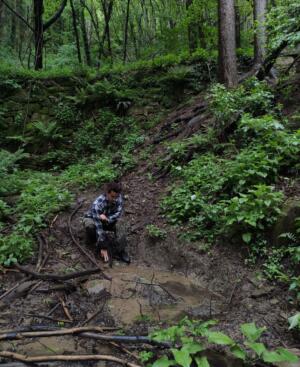
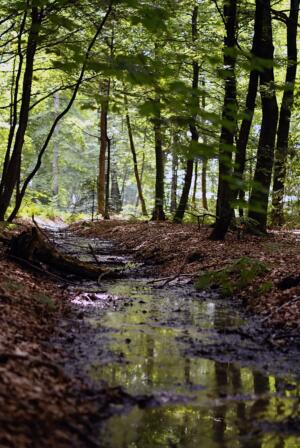
For centuries, the ancient woodlands of the Sant’Antonio Forest maintained their ecological equilibrium through natural cycles and traditional micro-habitat structures. However, intense past human interventions, modern climate pressures, and environmental degradation have triggered a progressive loss of biodiversity within this critical terrestrial ecosystem, risking a severe impoverishment of its biotic and abiotic components. In particular, historical reforestation efforts in the 1960s and 70s introduced non-native tree species (Pseudotsuga menziesii). The accumulation of fallen non-native trees, sediment, and debris washed down from upstream roads completely compromised the area’s natural wetlands, causing scarce surface water to rapidly infiltrate the altered substrate instead of sustaining local wildlife.
The solution
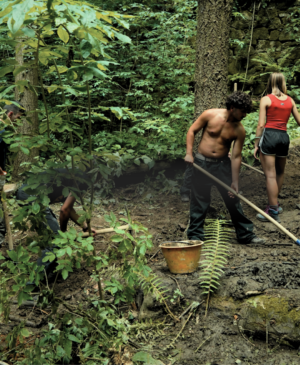
This project implements an innovative Nature-Based Solution by driving the comprehensive ecological restoration of a critical wetland habitat located near a natural spring and stream within the Sant’Antonio Forest. Through an entirely manual, low-impact field intervention – completely avoiding polluting machinery like tractors or chainsaws to protect the woodland’s peace – the grantee and its partners actively revitalize the forest’s micro-ecosystems. Crucially, the project integrates massive local community engagement, traditional eco-fencing techniques, and cutting-edge natural clay waterproofing. This framework proves that long-term forestry protection, scientific research on endangered IUCN Red List species, and active community resilience can go hand in hand.
Watch the TGR Toscana TV report on the project 👉 here
Project Objectives & Deliverables
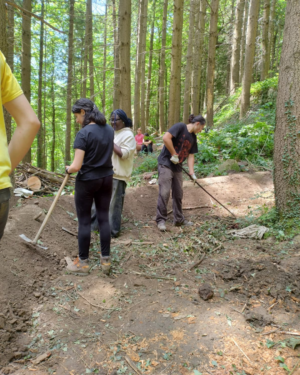
- Restoration of the wetland area: Excavation and manual removal of material accumulated over time (soil and stones) to create an area of about 40m² with depth points reaching about 90cm and portions reaching just over 5cm.
- Creation of a pool for the Yellow-bellied toad: Realization of a smaller “pool” of about 2×1 meters, close to the larger wetland area, situated in a sunny spot and with a depth ranging from 0 to 10cm.
- Natural waterproofing: Setting up the bottom and banks through the distribution of natural clay without the aid of bentonite or plastic sheets .
- Protection of the area: Construction of a fence with timber collected from the ground and arranged according to ancient techniques to prevent entry to species like wild boars, and arrangement of the path to visit the area.
- Monitoring and Census: Census of the herpetofauna and plant species using non-invasive, highly effective survey techniques.
- Regulations modifications: Initiation of the transformation of the Rete Natura 2000 Sant’Antonio regulation and the methods of utilization of the area
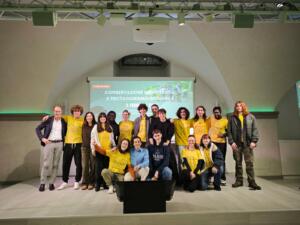
- Valorization and Conference: Information campaigns at schools, entities, public initiatives, social media, TV, radio, and press, and the organization of the Return Conference to be held on February 5 at the Florence Auditorium
Project Updates
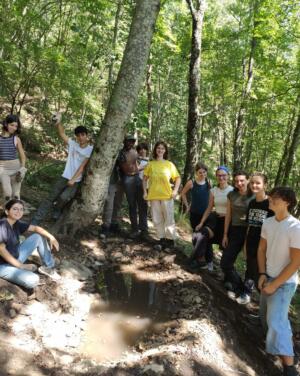
- Completion of manual works: The excavation work ended in mid-November, the stabilization of the clay bottom took place in December, and the final setting up of the bottom with the entry of water from the nearby spring and the placement of soil, stones, branches, and leaves was completed in January. During the works, the living beings present (earthworms, frogs, macroinvertebrates, ferns, ivy, etc.) were relocated each time to suitable neighboring areas.
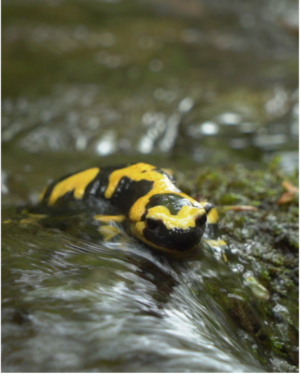
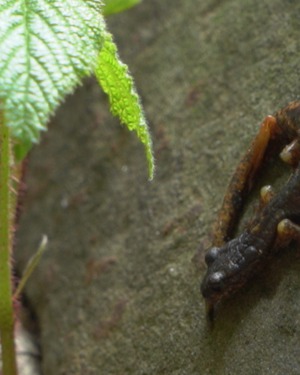
- Biological monitoring results: Monitoring has ascertained the presence of species such as Bufo bufo, Rana dalmatina, Rana italica, Salamandra pezzata (Fire salamander) and produced unprecedented data for the Bosco di Sant’Antonio regarding the presence of threatened species never previously censused: Speleomantes italicus, Triturus cristatus, and the very rare Bombina pachypus (Apennine yellow-bellied toad). Preliminary observations show that the wetland area is already drawing to itself animal species like the Black woodpecker, Green woodpecker, Eurasian jay, Buzzard, Song thrush, and Robin.
- Social involvement data: The call to be a volunteer for the work received a response from 50 people (also coming from far away like Rome and Pavia), in addition to 63 teenagers who succeeded one another in the work during the summer period and autumn weekends. Media dissemination through social networks reached about 150 thousand people.
- Institutional networks and Conference: A convention is being drawn up with the department of biology of the University of Florence, and active involvement was secured from the Unione dei Comuni Valdarno e Valdisieve, the municipalities of Pelago and Montemignaio, the Carabinieri Forestali of the Vallombrosa Nucleus, and the Foreste Casentinesi National Park. The project for the conference of February 5 was distributed to 25,000 addresses of CESVOT and involved numerous Higher Scholastic Institutes across Tuscany.

Long-term impact
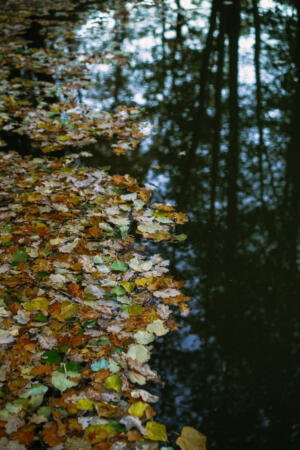
By integrating rigorous scientific field conservation with local community stewardship, this project establishes a fully replicable, low-cost model for regional forest and wetland management across Italy, aligned with the legacy of the Ramsar Convention. The project also stimulates local entities, primarily the Municipality of Reggello, to start the procedure to make the Sant’Antonio area a Regional Natural Park and, in the future, a National one. The active stabilization of the wetland habitat introduces permanent humidity back into the forest, providing a reliable water source for avian species and small mammals. Furthermore, it opens unprecedented avenues for the scientific community to study ecological colonization timelines in mountain woodland environments. Ultimately, the project ensures that the natural heritage of these woodlands leaves a living, functional, and fully protected ecosystem to an engaged, aware, and active generation of young conservationists.